
About Us
AVTTI is a leading technical training institute providing quality education and skill development programs.
Please fill out the form below and we will get back to you as soon as possible.
AVTTI is a leading technical training institute providing quality education and skill development programs.
Available Seats
Student Rating
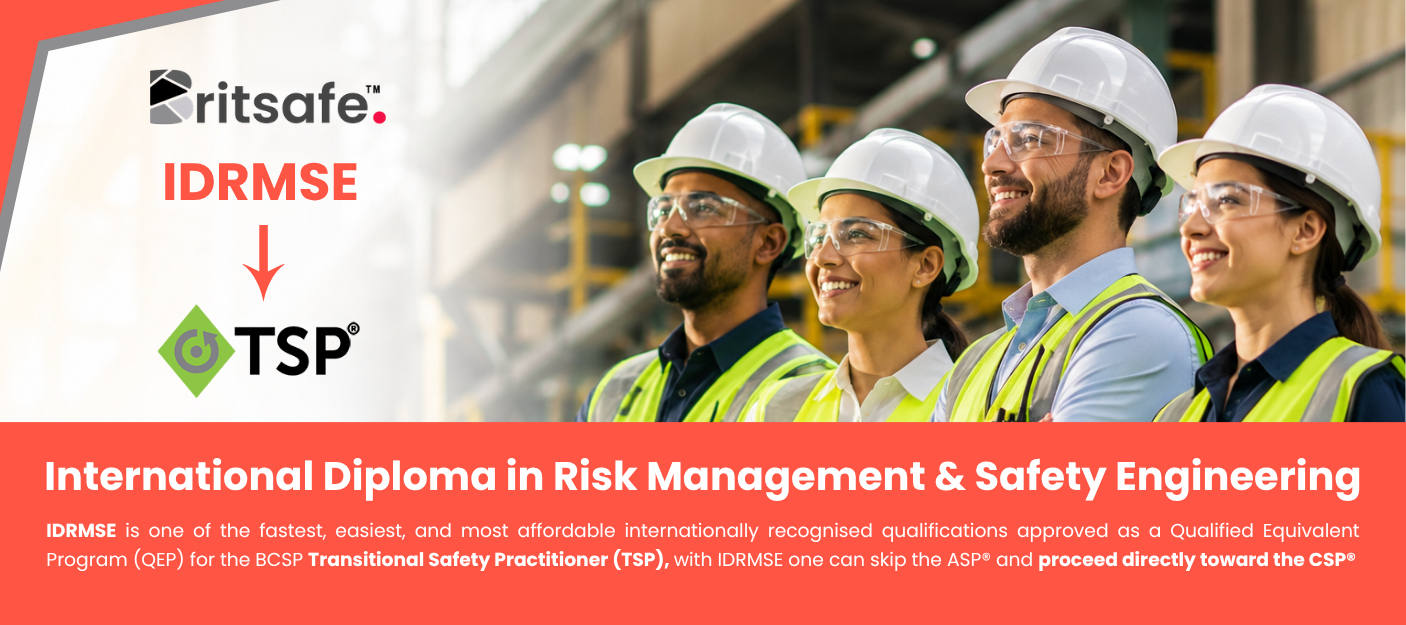
The International Diploma in Risk Management & Safety Engineering (IDRMSE) by Britsafe Qualifications is an internationally recognised professional qualification designed for occupational health, safety, and risk management professionals. As a BCSP Qualified Equivalent Program (QEP), eligible candidates can obtain the Transitional Safety Practitioner (TSP) credential and proceed directly toward the Certified Safety Professional (CSP®), subject to BCSP eligibility requirements.
1.1 Engineers as Catalysts for Technological Evolution
1.2 Role in Technological Advancements
1.3 Occupational and Public Safety in the United States: Trends, Impacts, and Evolving Risks
1.4 Consumer Safety, Transportation Incidents, and Environmental Hazards
1.5 The Role of Engineers in Ensuring Public Health, Safety, and Welfare
1.6 Safety Professionals: Roles, Contributions, and Specialized Disciplines
1.7 Management Sciences and Risk Management in Safety
1.8 Importance of Good Risk Management in Occupational Health and Safety
1.9 Objectives and Benefits of Risk Management Systems (RMS)
2.1 Understanding Management System
2.2 The Multidisciplinary Nature of Health and Safety
2.3 Barriers to Achieving High Standards in Health and Safety
2.4 Rationale for Organizational Management of Health & Safety
2.5 Fault and No-Fault Insurance Processes
2.6 Role of International Bodies: International Standards and Conventions
2.7 Origins and Development of the Legal Framework for OHS
2.8 Occupational Health and Safety Regulations: International and National Regulatory Regimes
2.9 Systematic Safety and Health Management
2.10 Designing an Occupational Health and Safety Management System Using a Process Approach
2.11 Critical Factors in Planning an Occupational Health & Safety Management System
2.12 Processes in the Occupational Health & Safety (OHS) Management System
3.1 Effective Resource Management for Implementing an OHS Management System
3.2 Record Keeping in Occupational Health and Safety (OHS) Management Systems
3.3 Importance of Competency in OHS Management
3.4 The Role of Communication in an OHS Management System
3.5 Importance of Occupational Health and Safety (OHS) Culture
3.6 The Role of Formal and Informal Leadership in Organizations
3.7 The Impact of Human Factors on Occupational Health and Safety Performance
3.8 Effective Communication within an Organization
3.9 Workers' Engagement and Participation in OHS Management System
3.10 Employee Training and Development in OHS Management
3.11 Code of Conduct for Professionalism and Ethics as Outlined by IOSH
3.12 Embracing Diversity and Inclusion in the Workplace
3.13 Correcting and Preventing Workplace Hazards
3.14 Information Sources for Effective Health and Safety Implementation
3.15 Crisis Management and Response Protocol
4.1 Proactive and Reactive Monitoring Approaches in OHS Management
4.2 Incident Analysis: Procedures, Types, and Investigative Approach
4.3 Incident Documentation and Notification
4.4 Theories on Incident Causation
4.5 Occupational Health and Safety Auditing
Module 5: Management Review Process for Occupational Health and Safety Management Systems
5.1 Factors Driving Change in the OHS Management System
5.2 Management Review
5.3 Management of Change (MoC)
1.1 Physical and Mechanical Properties of Materials
1.2 Hazards and Control Measures Related to the Mechanical Properties of Materials
1.3 Forms of Energy
1.4 Physical Concepts and Their Occupational Health and Safety Importance
1.5 Noise and Its Impact on Occupational Health and Safety
1.6 Simple Machines
1.7 Mechanical Structures: Purpose, Design, and Importance of Inspection
1.8 Fall Protection and Fall Prevention
1.9 Ergonomics: Mitigating Musculoskeletal Disorder (MSD) Risks
1.10 Mathematics in OHS
1.11 Statistics and Their Use in Safety
2.1 Fundamental Chemistry for Safety Professionals
2.2 Introduction to Chemical Agents
2.3 Epidemiology
2.4 Classification of Chemicals Based on Health, Safety, and Environmental Risks
2.5 Immune Responses to Chemical Agents
2.6 Regulatory Compliance for Chemical Control
2.7 Types of Health Effects Based on Dose Quantity
2.8 Chemical Processes and Effects on Occupational Health & Safety (OHS)
2.9 Monitoring and Measuring Hazardous Substances in the Workplace
2.10 Managing Risks Through Environmental Conditions and Hazardous Properties
2.11 Risk Control Measures for Hazardous Substances
2.12 Emergency Procedures
2.13 Clean Energy and Occupational Health and Safety Implications
2.14 Common Hazardous Chemical Agents in the Workplace
2.15 Requirements for a Safe and Comfortable Work Environment
3.1 Non-Destructive Testing (NDT) Methods
3.2 Destructive Testing Methods
3.3 Factors Contributing to Material Failures
3.4 Measurement Uncertainty
4.1 Valves
4.2 Pumps
4.3 Powered Industrial Vehicles
4.4 Pascal's Law and Industrial Applications
4.5 Locking and Braking Devices in Industrial Applications
5.1 End-User Requirements for Tool, Equipment, and Machinery Design
5.2 The Impact of a Well-Designed Tool, Equipment, and Structures on Occupational Safety and Health
5.3 ASME (American Society of Mechanical Engineers) and Its Role in Occupational Safety and Health
5.4 The Role of Design Testing Software in Ensuring Safety and Efficiency in OHS
5.5 Material Failure Investigations
6.1 Principles of Electricity
6.2 Effects of Electric Shock on the Human Body
6.3 Risk Factors for Accidents Related to Electricity and Electric Equipment
6.4 Types of Hazardous Environments that Might Affect the Physical Condition of Equipment
6.5 Types of Protective Systems in Electrical Safety
6.6 Types of Inspection for Electrical Systems & Equipment
6.7 Emergency Preparedness and Response for Electricity Hazards
7.1 The Fundamentals of Fire and Fire Terminologies
7.2 Principles of Fire Spread
7.3 Causes of Fire Initiation at Workplaces
7.4 Requirements for Fire Risk Assessment
7.5 Precautions Against Fire: Risk Control Measures
7.6 The Role of Continued Research and Development
8.1 Fission Reaction and Fusion Reaction
8.2 Health and Safety Implications of Atomic Power Plants
8.3 Radiation: An Invisible Hazard
8.4 Engineering Controls for Ionizing Radiation
9.1 Biological Agents and Workplace Exposure
9.2 Biological Agents and Biological Hazards in the Workplace
9.3 Hazards Posed by Biological Agents
9.4 Industrial Hygiene: Safeguarding Workplace Health
9.5 The Relationship Between Occupational, Environmental, and Public Health
9.6 Rehabilitation and Workplace Adjustments
10.1 The Role and Relevance of Engineering Controls in Occupational Safety
10.2 Effectiveness of Engineering Controls
10.3 Engineering Controls for Potential Explosion Hazards
10.4 Are Engineering Controls Fail-Safe?
11.1 Advancements and Innovations in Information Technology for Occupational Health and Safety
11.2 Leveraging Information Technology for Training, Awareness, Communication, and Incident Investigations
11.3 Enhancing OHS Communications Through Information Technology
11.4 IT-Based Occupational Health and Safety (OHS) Management Systems
11.5 Leveraging Information Technology to Address OHS Hazards
11.6 Security and Legal Concerns in IT-Driven OHS Management
- Internationally Recognised Qualification
- BCSP Qualified Equivalent Program (QEP)
- Eligible Pathway to Transitional Safety Practitioner (TSP)
- Skip ASP® and Progress Toward CSP®*
- Interactive LMS with Video Lectures
- Comprehensive Study Materials
- Flexible Self-Paced Learning
- Dedicated Learner Support
- Career Advancement Opportunities
- Practical Knowledge in Risk Management & Safety Engineering
Duration
8 WeeksSkill Level
BeginnerLanguage
EnglishCertificate
After CompletionSeats Available
25You can study anytime anywhere
Our Courses are more affordable
All the details will be safely stored